In the first part, we discussed the features of useful language learning apps and important considerations. Now, we'll examine the features of Duolingo.
Key Features of the Duolingo App
A language learning app should have features similar to the following.
1. Login
For designing a language learning app, you need a robust identity verification system. Duolingo simplifies this: answer a few questions (age, gender, email, name), enter a password, and you're done!
To simplify the process, we recommend adding social media login options.
2. Filling out Personal Information
Once a user has an account, they should enter their details. To build a language learning app like Duolingo, you should request the following data:
- Personal Information: This means obtaining information related to the individual's identity, such as age, gender, and photo (if necessary).
- Provide a comprehensive list of languages the user can learn, not just popular options like English, French, and German.
- Set a daily goal: How many minutes per day will the user need to use the app?
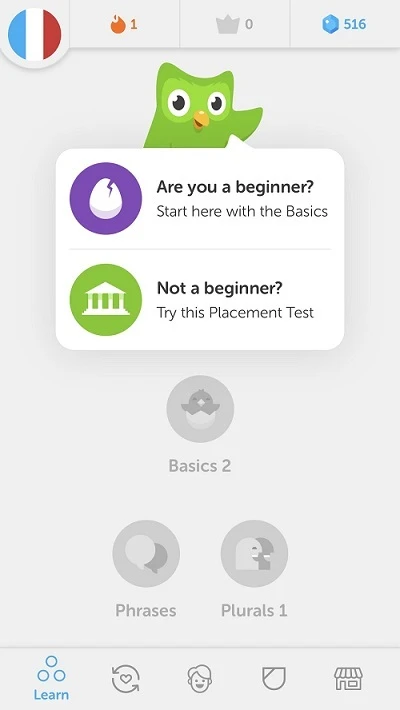
- Determine language level: If a user knows the basics of a specific language, they can take a test to determine the best starting point for their course.
Learning
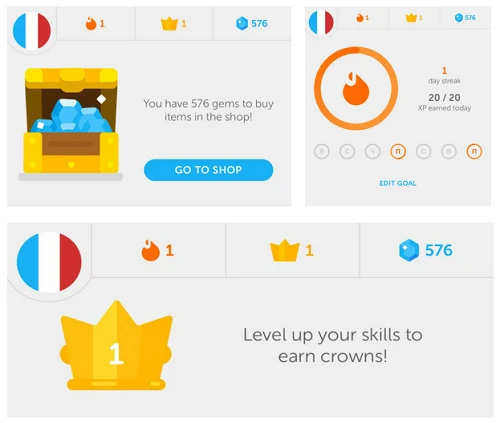
The main screen, which acts as a dashboard, allows users to view their achievements and progress, providing tools for the learning process.
The user sets a goal and then completes daily exercises to earn points.
Upon successful completion of tasks, the user receives coins as a reward, which can later be used in the Duolingo shop (we'll discuss this later).
When designing a language learning app similar to Duolingo and Memrise, consider your reward system.
Duolingo offers various lesson types, such as:
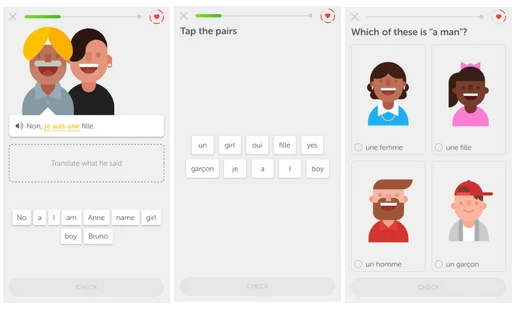
- Matching words: The user is given a set of words in two languages (native and target) and must find the matching pairs.
- Translating audio phrases: The user sees a phrase in their target language. The same phrase is displayed below a corresponding image. The user's task is to provide a translation using suggested words (by dragging and dropping).
- Choose the image: The user sees several pictures with short descriptions in the new language. They must select the one that answers the question (e.g., "Which of these images is a girl?").
- Multiple-choice translation: A relatively simple but effective way to teach those interested in starting language learning through an app.
- Writing words: The user must write a phrase using suggested words.
- Fill in the blanks: The user sees a phrase with a missing word and must guess it.
- Translate and record: A very engaging exercise requiring microphone access. The user reads a phrase in their native language and must translate it aloud. Pronunciation plays a key role here.
- Notifications: Duolingo is generous in providing additional explanations. Users can tap highlighted words to see translations and usage examples.
- The user dashboard is for monitoring achievements.
Daily statistics show the user's progress throughout the day: whether all tasks were completed. Additionally, the user can edit their goal (if they decide to spend more time studying daily).
- Awarding crowns: Users earn a crown after reaching a certain level of knowledge.
- Coins: As previously explained, coins are needed for purchases from the Duolingo shop.
4. Health
This is a fascinating feature implemented by the Duolingo language learning app.
Mistakes are inevitable when learning a new language. Duolingo penalizes such mistakes to motivate users to learn.
Reducing earned coins is a simple solution. However, Duolingo takes a different approach. Each mistake weakens the user's virtual health, and if their health reaches zero, they cannot continue learning and must review their mistakes. Health regenerates over time.
This approach allows users to learn in a gamified way. When designing a free language learning app like Duolingo, consider incorporating gamification (as we mentioned earlier, it's crucial).

5. Friendship Groups
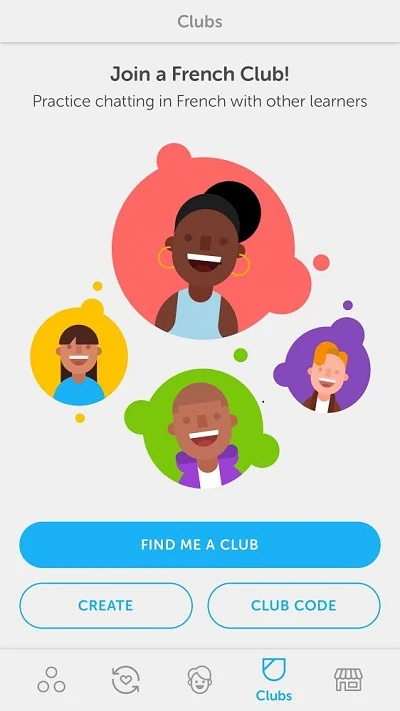
The friendship groups/clubs feature allows users to connect with other Duolingo enthusiasts. Users can create their own clubs or join existing ones using the "Find a Club" option.
Thus, by creating a language learning app, a platform for connecting people worldwide is also built.
6. Shop
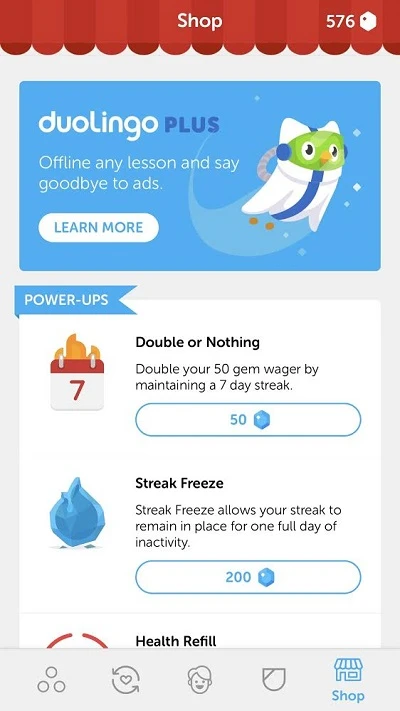
The shop feature allows users to convert coins earned through learning into real purchases related to using Duolingo. These coins can be earned as rewards or purchased. If you want to create a language learning app like Duolingo and monetize it, you need multiple avenues for generating revenue. This is one of them.
Conclusion
As you know, you need to hire experts to implement a language learning app. Here's a summary of the steps you should take:
Determine the appropriate format for your language learning app and consider all details.
Hire developers. Use our colleagues' guidance for your app design.
Create a list of requirements for language learning app design. Let developers tell you which of your ideas are technically feasible and how much they cost.
Prioritize marketing. While the app development process is underway, think about your advertising campaign. Designing a language learning app isn't enough; you must promote it!
We hope we've adequately explained the various aspects of designing a language learning app. Contact us for more services in the field of custom app design.