Comparing mobile website design versus mobile app design can be a heated debate. Join us in this article to explore their differences.
Many believe you don't need a mobile app; a mobile-friendly website suffices. Others argue that mobile apps offer advantages a website can't. Which claim holds more weight?
Every business needs a responsive website that loads correctly on mobile devices. People want to access your website on their mobile devices. Clearly, you need a responsive website, but do you also need a mobile app? Is a mobile app better than your mobile website?
Let's examine whether mobile app design is superior to mobile website design for your business.
Advantages and Disadvantages of Mobile Website Design
A mobile website isn't usually a separate website; it's a responsive design ensuring your site functions correctly on all screen sizes. Mobile visitors should access more of your website content, optimized for smaller screens.
We believe everyone should have a mobile website; therefore, these advantages/disadvantages are primarily for comparison with a mobile app.
Advantages of Mobile Website Design
- Cost-effective – usually included in your website design price.
- Compatible with all devices – you don't need separate sites for iOS or Android.
- Easy setup – no app stores needed; you only require a domain and hosting.
Disadvantages of Mobile Website Design
- Inability to send push notifications
- No offline access
- Absence from app stores
- Poor design can lead to issues such as:
- Poor performance
- Ambiguous design
- Difficult accessibility
A well-designed mobile website can be a significant business asset. With nearly a third of internet traffic originating from mobile devices, its necessity is evident.
Mobile websites are inexpensive to set up, accessible on all devices, and easily maintained and updated.
Weaknesses of Mobile Websites
Numerous websites are not mobile-optimized, leading to user bounce. Often, these poorly designed mobile sites are cluttered with ads, pop-ups, and unnecessary content for mobile users.
Conversely, some mobile websites are over-optimized, attempting to mimic a native app experience. This often worsens the user experience. Even large companies make these mistakes. The image below (left) shows a site with excessive extra sections, hindering readability.
The image on the right, even worse, displays a non-responsive site where the text is unreadable on mobile, further complicated by a pop-up!
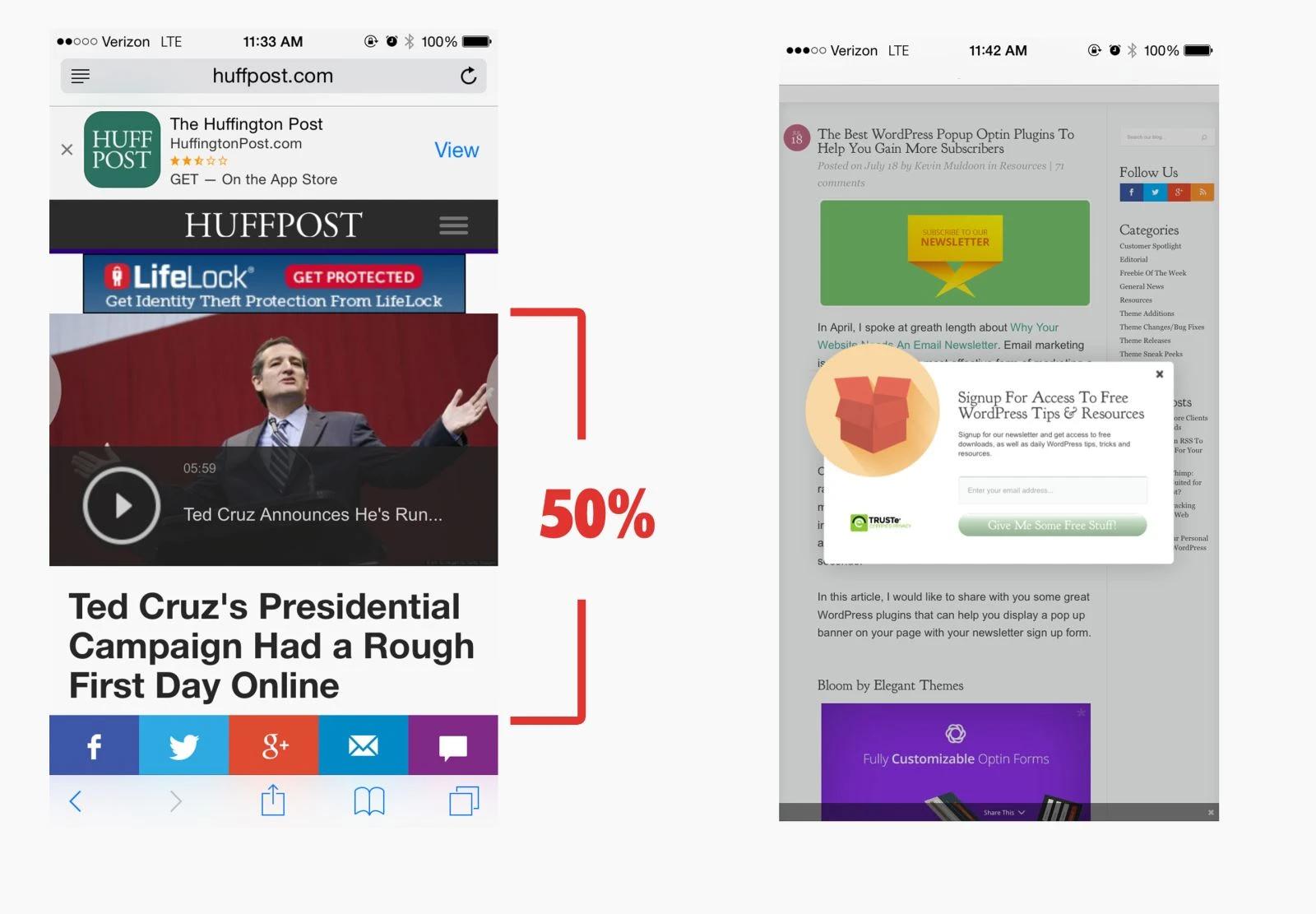
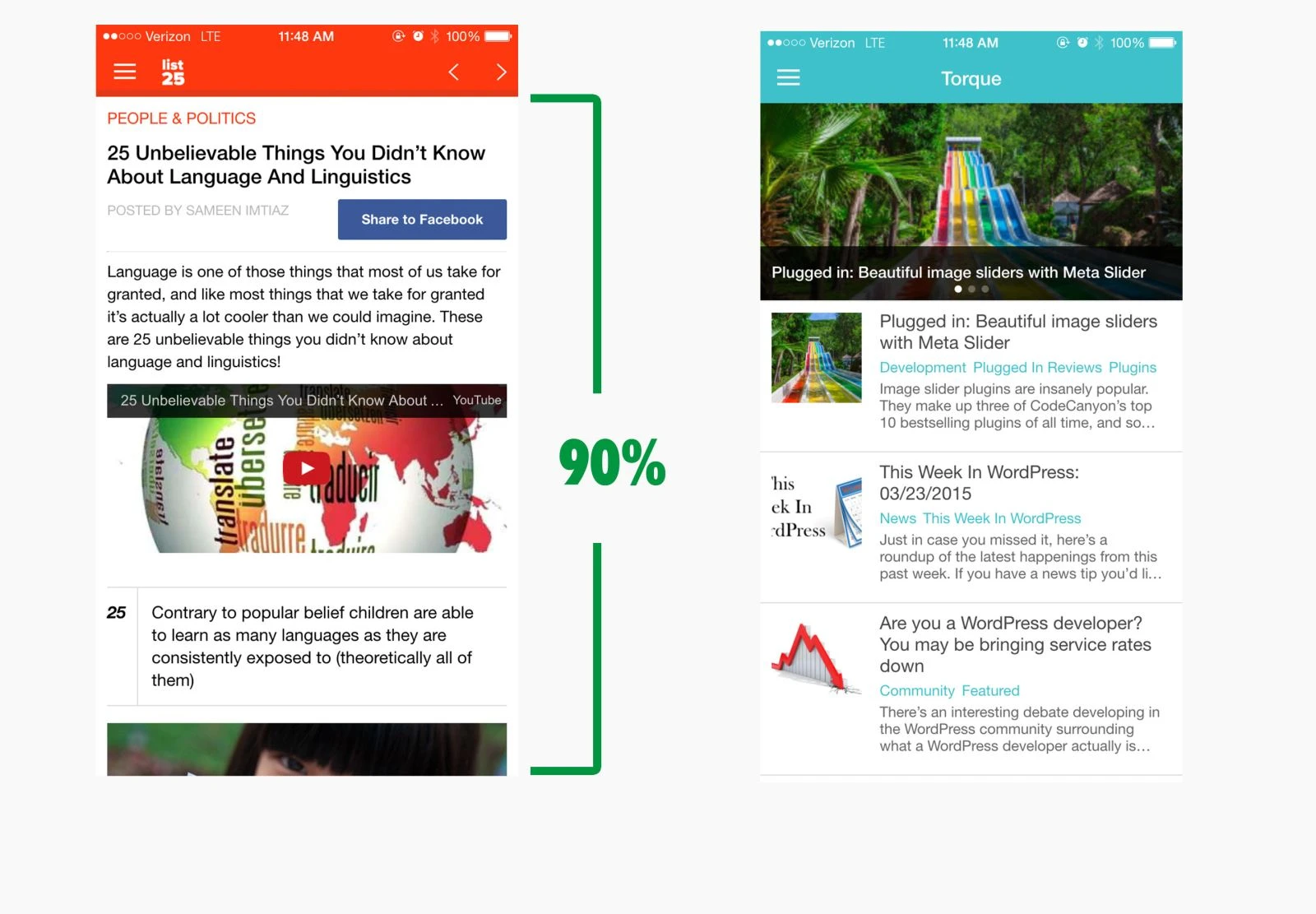
A well-executed mobile website design can mitigate many of these issues, but it still can't replicate the functionalities of a mobile app. The image below shows a mobile app where content occupies 90% of the screen, resulting in a superior user experience.
Let's explore the advantages and disadvantages of a mobile app.
Advantages and Disadvantages of Mobile App Design
Mobile apps offer functionalities websites lack, such as push notifications and offline access. However, mobile apps also have drawbacks. Mobile app design isn't essential for everyone; for instance, a blogger with infrequent updates likely doesn't need one. Nevertheless, many businesses benefit; let's examine the pros and cons.
Advantages of App Design
- Push notifications – send text messages to your subscribers
- Offline access – read articles, listen to podcasts, or browse product catalogs offline
- Excellent performance – professional app design can be faster than a website
- Less ambiguity – depending on website design quality, apps offer greater clarity
- Downloadable from app stores – you also get a mobile icon
Disadvantages of App Design
Additional cost – app design is typically more expensive than website design.
Additional setup – you must launch and submit your app to app stores
Mobile apps can quickly guide users to desired content and enhance engagement. Sending push notifications when new articles are published or products are on sale is a significant advantage.
So, who wins?
The winner depends on your business. For a low-traffic blogger, a mobile website wins. For a company like Instagram, a mobile app wins.
For many businesses, the winner is a combination of both. A dual mobile strategy utilizes both a mobile website and a mobile app for maximum content distribution.
An example could be an online store. Why not allow visitors to purchase through both your website and your app? Restaurants can offer menus and online ordering. Magazines can send push notifications when new articles are published.
Instead of choosing one, consider both mobile strategies.